
Why Louisiana Pecans Are Special: The Story Behind Our Southern Harvest
11th Jun 2026
Louisiana didn't just adopt the pecan. It shaped the entire industry. The first commercially grafted pecan tree in recorded history was created right here in 1846, by a man named Antoine, an enslaved gardener at Oak Alley Plantation on the Mississippi River. He took a cutting from a wild pecan tree with exceptionally large, thin-shelled nuts and grafted it onto rootstock, creating a named variety called Centennial. That single graft changed everything. It proved that pecan trees could be selectively bred for quality the same way orchards breed apples or peaches, and it turned the pecan from a wild foraged nut into a commercially viable crop. Every improved pecan variety grown in the United States today traces its lineage back to that technique, and it started in Louisiana. At Natchitoches Pecans, we've been growing pecans at Little Eva Plantation in Cloutierville since 1987, and every harvest season reminds us that we're part of a story that's been unfolding in this soil for centuries.
Here's why Louisiana pecans are different, and why the place they come from genuinely matters.
The Climate That Grows a Better Pecan
Pecan trees are native to the Mississippi River valley. They didn't get introduced here or transplanted from somewhere else. This is where the species evolved over thousands of years, and Louisiana sits right in the heart of that native range.
That matters because the trees are adapted to exactly this climate. Louisiana averages about 217 sunny days a year with regular rainfall and warm temperatures that hover around 70 degrees on average. The summers are long and hot, which is exactly what pecans need during the months when the nuts are developing inside their husks. The winters are mild enough that the trees survive comfortably but cold enough to trigger the dormancy period pecan trees require to produce well the following year.
The soil plays an equally important role. Louisiana's river-bottom land, especially along the Red River and Cane River where our orchard sits, is loamy soil loaded with organic material. It drains well but holds moisture, which is the combination pecan trees thrive on. The soil pH in our region runs around 6.5, which happens to be close to ideal for pecan roots.
None of this is marketing language. It's basic agriculture. Pecan trees grow in 15 states across the southern US, and they produce good nuts in many of them. But the trees that grow in the soil and climate they evolved in produce differently than trees planted in arid western soil that depends entirely on irrigation. The flavor profile is different. The oil content is different. The texture is different. Louisiana pecans tend to be richer and more buttery than their western counterparts, and that's not opinion. It's what happens when a tree grows in the conditions it was built for.
The History That No Other State Can Claim
Louisiana's connection to the pecan industry goes deeper than climate. The state played a central role in nearly every milestone that turned the pecan from a wild nut into a commercial crop.
Native Americans in the Mississippi valley were eating and trading pecans long before European settlement. When French colonists arrived in Louisiana in the 1700s, they adopted pecans into their diet almost immediately. New Orleans, as one of the busiest international ports in the Americas, became the commercial hub for buying, selling, and exporting pecans. That's where the business of pecans started, not in Georgia or Texas, but in Louisiana through the Port of New Orleans.
Then came the 1846 grafting breakthrough at Oak Alley. Antoine's Centennial variety won the Best Pecan Exhibited award at the Philadelphia Centennial Exposition in 1876, which put Louisiana pecans on the national stage. His original 1876 planting eventually grew to 126 Centennial trees, making it the first official planting of improved pecans anywhere.
The first commercial nursery to sell grafted pecan trees was the Richard Frotscher and William Nelson Nursery of New Orleans, in the 1880s. Louisiana farmers experimented with more varieties, and the state played a major role in shaping the future of the commercial pecan market across the entire South.
Then there's the research. LSU's Horticulture Department supported pecan research from the early 1900s through the 1980s. In 1930, a USDA Pecan Field Laboratory was established south of Shreveport on 100 acres donated by Caddo Parish. That station, which later transferred to the LSU AgCenter in 1973, remains the only university branch station in the country dedicated exclusively to pecan research and extension. Nowhere else. Only Louisiana. Research conducted there led to discoveries including the critical role of zinc in pecan nutrition and growth, definitive studies on rootstock, and identification of major pecan diseases.
The praline was invented in Louisiana. The pecan pie as we know it has deep Louisiana roots. The commercial pecan industry launched from Louisiana. The science of growing better pecans was pioneered in Louisiana. This isn't a state that happens to grow pecans. It's where the pecan became what it is today.
The Varieties We Grow at Little Eva Plantation
Our pecan orchard at Little Eva Plantation grows several varieties, each with its own character.
Desirable makes up more than half our orchard, and there's a reason for that. It's a large pecan with golden kernels and excellent flavor, classified as a "semi-papershell" because the shell is thin enough to crack easily but sturdy enough to protect the nut during harvest and handling. It's our most versatile variety: beautiful as whole halves on top of a pie, rich enough to eat straight from the shell, and consistent enough to bake with confidently. Desirable is the all-around pecan that does everything well.
Elliot is our personal favorite, and if you ask us what to snack on, this is the one we'll hand you. It produces a round, medium-sized nut with excellent cracking characteristics and bright, well-flavored kernels. Elliot is especially popular in south Louisiana because it handles the higher disease pressure of our humid climate better than many varieties. The oil content is high, which means the flavor is rich and buttery.
Stuart is one of the classic Louisiana varieties. It's been grown here for generations and it's a reliable producer with good-sized nuts. Stuart is the variety many people picture when they think of a traditional Southern pecan.
Sumner is a newer variety that produces large, attractive nuts with good kernel quality. It fills out well and cracks cleanly.
Candy produces medium-sized nuts with excellent flavor and good shell characteristics. It's a strong choice for eating and baking.
Branch and Melrose round out our orchard, each contributing their own qualities to the harvest. Growing multiple varieties isn't just about offering options. It's also about pollination. Pecan trees are wind-pollinated, and having varieties with different blooming characteristics planted near each other improves pollination and nut set across the entire orchard.
From Tree to Table: What Happens at Harvest
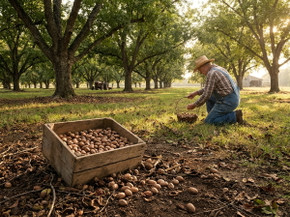
Pecan harvest in Louisiana runs from mid-October through November and sometimes into December, depending on the variety and the weather. It's the most intense season of our year, and the timing matters more than people realize.
When the nuts are ready, the green outer husks split open and the pecans begin to drop. In a commercial orchard like ours, mechanical tree shakers are attached to the base of the tree and shake the trunk, causing the ripe pecans to fall. This sounds rough, but it's actually gentler on the tree than you'd think, and it's the only way to harvest the volume a working orchard produces.
Here's the part that affects quality: pecans lose freshness quickly after they hit the ground. Moisture from the soil, insects, and heat all work against the nut once it's on the ground. That's why gathering pecans soon after shaking is essential. The faster the nuts move from the ground to cleaning and drying, the better the final product.
After harvest, the pecans are cleaned, washed, and air-dried for two to three weeks. This drying period is critical because it brings the moisture content down to a level where the nuts will store well without developing mold or off-flavors. If they're going to be stored for more than a few weeks, they go into cold storage.
Our fresh shelled pecan halves are grown, shelled, and packaged right here at the orchard. They don't sit in a warehouse for months. They don't get shipped to a processing facility in another state and shipped back. They go from our trees to our processing to your door. That's the shortest path a pecan can take from tree to table, and it's why freshness is our real competitive advantage.
Why Freshness Matters More Than People Think
This is the part we can speak to from genuine daily experience, because we handle pecans at every stage from the tree to the package.
Pecans are naturally high in unsaturated fats. That's the source of their rich, buttery flavor, and it's a big part of what makes them so nutritious. But those same fats oxidize when exposed to heat, air, and light. Oxidation is what turns a fresh, sweet pecan into a stale, flat, and eventually bitter one.
A pecan that was harvested, properly dried, and stored cold tastes completely different from one that's been sitting in a warm warehouse or a retail shelf at room temperature for months. The fresh one has a clean, sweet nuttiness with a buttery finish. The old one tastes papery and dull, and if it's far enough gone, it has a sharp, almost chemical bitterness that no recipe can hide.
This is why where you buy your pecans matters. A bag from a grocery store shelf might have been harvested a year ago, processed, shipped to a distributor, shipped to a warehouse, shipped to a store, and sat on the shelf for weeks or months. At every step, the clock is ticking on those fats. A bag from a grower who shelled them recently and shipped them directly to you is a fundamentally different product, even if the variety is the same.
When we ship pecan pieces or halves from Little Eva Plantation, they're as close to tree-fresh as a shipped product can be. That's not something a middleman can replicate, and it's the reason our returning customers come back year after year.
The Clementine Hunter Connection
Little Eva Plantation has a history that extends well beyond pecans, and it's a history worth knowing.
The plantation was originally called Hidden Hill, and it's said to be the real location that inspired Harriet Beecher Stowe's classic novel Uncle Tom's Cabin. That connection alone makes it one of the most historically significant sites in Louisiana.
But for many visitors and customers, the name they recognize is Clementine Hunter. Hunter was a self-taught folk artist who spent most of her life at nearby Melrose Plantation on the Cane River, just a few miles from Little Eva. Her vivid, colorful paintings of plantation life, cotton picking, church gatherings, and everyday scenes in rural Louisiana made her one of the most celebrated folk artists in American history. Her work hangs in museums across the country.
We carry a Clementine Hunter collection of ornaments, gifts, and art-inspired items because her story and ours are part of the same Cane River landscape. The connection isn't manufactured. It's geographic and historical. These plantations, these rivers, these pecan trees, and these artists all share the same soil.
Louisiana Pecans in the Kitchen
Louisiana's culinary tradition and its pecan tradition are inseparable. The praline was invented here, a confection of sugar, cream, and pecans that remains one of the most iconic Southern sweets. Pecan pie as an American dessert has deep Louisiana roots. Pecan-crusted fish, pecan-topped sweet potatoes, pecan brittle, butter pecan ice cream, and dozens of other dishes trace their origins or their popularity to Louisiana kitchens.
For baking, the variety and form of pecan you choose actually matters. Whole pecan halves are what you want for the top of a traditional pecan pie or for any dish where the pecans are on display. Pecan pieces work better for cookies, brownies, banana bread, and any recipe where the pecans are mixed into the batter. In-shell pecans are perfect for cracking at the table, for holiday snacking, and for people who enjoy the ritual of shelling their own.
For gifts, our pecan gift tins and candied pecan varieties make the kind of present that people actually eat and remember rather than setting on a shelf.
Bottom Line
Louisiana pecans are special because of the combination of native climate and soil, centuries of cultivation history, and the fact that this state literally invented the modern pecan industry. The first grafted pecan, the first commercial nursery, the only dedicated pecan research station in the country, the Port of New Orleans as the original export hub, and the culinary traditions that made pecans a centerpiece of Southern food all started here.
At Little Eva Plantation, we're a small piece of that much larger story. We grow Desirable, Elliot, Stuart, Sumner, Candy, Branch, and Melrose varieties in the same Cane River soil that's been growing pecans for longer than anyone alive can remember. We harvest, process, and ship from the orchard, which means the pecans you receive are as fresh as a shipped product can possibly be.
If you've only ever had pecans from a grocery store bag, trying orchard-direct Louisiana pecans is the kind of difference you taste immediately. It's the difference between a nut that sat in a supply chain for months and one that went from tree to your table as fast as we could get it there.