
How Fast Do Pecan Trees Grow? A Real Look Inside a Pecan Orchard
18th Jul 2026
A healthy young pecan tree can produce about 2 to 4 feet of new terminal growth in a year when it has suitable soil, water, sunlight and care. Some vigorous young trees may produce longer shoots in an especially favorable season. Growth becomes slower once the tree matures and begins putting more energy into producing pecans. A grafted tree may bear a small crop in roughly 3 to 8 years, depending on the variety and growing conditions, while a tree grown from seed may need 10 to 15 years or longer.
That is the short answer. The more useful answer is that growing taller and producing pecans are not the same thing.
A young tree can look as though it is growing quickly while still being years away from its first meaningful harvest. To understand the real timeline, it helps to look at what happens inside a working pecan orchard.
The quick pecan-tree growth timeline
| Tree stage | What is happening |
|---|---|
| Planting year | The tree is recovering from transplanting and establishing roots. Top growth may be limited. |
| Years 1–3 | Root development, trunk growth and canopy formation are the priorities. Healthy young trees may produce 2–4 feet of terminal growth annually. |
| Years 3–8 | Some grafted, early-bearing varieties may begin producing small crops. Other varieties need longer. |
| Years 8–15 | The canopy expands and production may become more consistent, although crop size still varies. |
| Mature years | Height growth slows as more energy goes into nuts, branches and trunk development. Production depends heavily on water, weather, pollination and crop load. |
These are broad ranges, not promises. Variety, location and orchard management can move a tree toward either end of the timeline.
What does “2 to 4 feet of growth” really mean?
It does not necessarily mean the entire tree becomes exactly four feet taller every year.
Growers commonly look at terminal growth: the length of new shoots produced at the ends of branches during the growing season. Those shoots help form the tree’s future canopy.
The University of Georgia and Mississippi State University both use approximately 2 to 4 feet of annual terminal growth as a healthy target for young pecan trees. Young seedlings can sometimes produce longer shoots, but rapid height alone is not proof that the tree is developing properly.
A grower also watches:
- Trunk development
- Branch strength and spacing
- Leaf size and color
- Canopy balance
- Root-zone moisture
- Disease or insect damage
- The amount of crop carried by older trees
A tree with one long, weak shoot is not necessarily healthier than a slightly shorter tree with a well-formed trunk and balanced branches.
Why young pecan trees grow faster than mature trees
During its early years, a pecan tree mainly builds structure. It is creating roots, a trunk and the branches that will eventually hold a crop.
New Mexico State University explains that pecan trees commonly grow vigorously during their first 5 to 10 years. Vegetative growth then begins to slow as nut production increases. Some young shoots can extend 3 to 6 feet in one season, although that should not be expected from every tree or in every year.
Once the tree begins bearing, its energy must be divided among several jobs:
- Producing new leaves and shoots
- Developing flowers
- Filling pecan shells and kernels
- Maintaining a larger trunk and root system
- Storing energy for the following season
For comparison, Oklahoma State University recommends approximately 4 to 8 inches of annual terminal growth for a mature bearing tree. A slower rate at that stage is normal and does not mean the tree has stopped developing.
A real orchard is growing more than trees
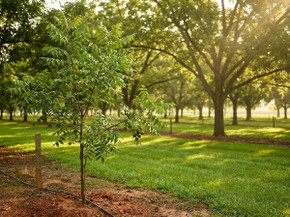
At Natchitoches Pecans’ orchard on Little Eva Plantation, rows of pecan trees are part of a long-term agricultural system. The orchard grows varieties including Desirable, Stuart, Elliot, Sumner, Candy, Branch and Melrose.
From a distance, the trees may appear to be doing all the work themselves. In reality, an orchard requires continual attention. Trees must be monitored for moisture, nutrition, insects, disease, branch structure and crowding.
The goal is not to force the fastest possible height growth. It is to develop a healthy tree that can carry quality pecans for many years.
That difference matters. Too little growth can indicate stress, but excessive soft growth can create weak branch angles, delay proper structure or make young tissue more vulnerable to weather damage. Steady, balanced development is usually more valuable than one dramatic growth spurt.
What controls how fast a pecan tree grows?
1. The tree’s age
Young, nonbearing trees usually grow faster because most of their energy goes into roots and branches. Mature trees divide their energy between growth and nut production.
2. Grafted tree versus seedling
A grafted tree is produced using a known pecan variety attached to suitable rootstock. Growers choose grafted trees because their nut characteristics and general bearing habits are more predictable.
A tree grown from a pecan is genetically different from its parent. It may grow vigorously, but it usually remains juvenile longer and may not produce the same type or quality of nut.
3. Variety
Some pecan varieties are considered precocious, meaning they begin bearing relatively early. LSU AgCenter identifies some cultivars that can begin bearing in approximately three to five years under favorable conditions. Other varieties require several additional years.
Early bearing does not automatically mean the variety is the best choice. Disease resistance, climate, nut quality, pollination and long-term crop consistency also matter.
4. Soil depth and drainage
Pecan trees naturally thrive in deep soils with room for large root systems. Shallow, compacted or poorly drained soil can restrict roots and slow the entire tree.
A low spot that remains waterlogged may look fertile, but roots also need oxygen. Constantly saturated soil can be as troublesome as dry soil.
5. Water
Young transplanted trees have limited root systems, so they cannot reach moisture as effectively as established trees. Consistent water during the establishment period is one of the most important influences on survival and growth.
Mature trees also need substantial water, especially while the nuts are developing. Drought can reduce shoot growth, nut size and kernel filling.
6. Sunlight and spacing
Pecan trees become very large. When they are planted too close together, their canopies eventually compete for sunlight while their roots compete for water and nutrients.
Crowding may not look serious when the trees are small. Years later, however, it can reduce lower-canopy production and force an orchard to remove or thin trees.
7. Nutrition
Nitrogen and zinc are especially important in pecan production, but fertilizer should not be applied blindly. Too little nutrition can limit growth; too much or poorly timed fertilizer can damage roots or encourage unsuitable growth.
Soil testing, leaf analysis and regional Extension guidance are more dependable than guessing.
8. Weather, insects and disease
Late freezes, drought, storms, insect pressure and diseases such as pecan scab can all reduce growth. The effect may appear as shorter shoots, damaged leaves, weak branches or a smaller crop.
How long before a pecan tree produces nuts?
A grafted pecan tree may produce a few nuts in approximately 3 to 8 years, depending on the variety and environment. Five or six years is a common early-production estimate for newer commercial cultivars, but the first crop is not the same as full production.
A seedling tree grown from a nut may take 10 to 15 years to produce. Some take even longer. LSU AgCenter specifically notes this longer juvenile period for seed-grown pecans.
The first harvest may be only a handful of nuts. Production generally increases as the canopy expands and the tree develops more fruiting wood.
Even a mature tree will not necessarily produce the same amount every year. Pecans naturally tend toward alternate bearing, meaning a heavy crop may be followed by a lighter crop. Weather, water, nutrition and crop management can make that pattern stronger or weaker.
How large does a mature pecan tree become?
Pecan trees are not small backyard fruit trees. A mature tree can reach approximately 70 feet or more, with a root system and canopy requiring considerable room. Some trees become substantially larger under favorable conditions.
That mature size is why a young pecan should be planted well away from:
- Houses and other buildings
- Overhead power lines
- Septic systems
- Driveways and paved areas
- Other large trees
- Locations where falling branches or nuts could create problems
The little nursery tree will not stay little. Choosing the planting location with its mature size in mind can prevent expensive problems later.
Can you make a pecan tree grow faster?
You cannot skip the tree’s natural juvenile stage, but you can prevent avoidable delays.
For healthy growth:
- Choose a grafted variety suited to your climate.
- Plant in deep, well-drained soil with full sun.
- Give the mature canopy plenty of space.
- Keep the root zone consistently watered during establishment.
- Control competing weeds and grass near young trees.
- Train a strong central leader and suitable scaffold branches.
- Use soil and leaf testing before making major fertilizer decisions.
- Monitor for insects, disease and weather damage.
- Follow recommendations from your local Cooperative Extension service.
The objective is not to push the tree into unnatural growth. It is to remove the stresses that keep it from growing normally.
The patient tree with a long reward
Pecan trees grow quickly when they are young, but producing a dependable crop takes patience. A healthy young tree may add several feet of terminal growth in a season while spending even more energy below ground where no one can see it.
Over time, that root system supports a broad canopy and decades of harvests.
For an orchard grower, the timeline is measured in years rather than weeks. That long view is part of what makes a fresh pecan special: every nut comes from a tree that has been planted, trained, monitored and cared for across many growing seasons.
To see where our Louisiana pecans are grown, visit the Little Eva Plantation pecan orchard. You can also shop fresh Louisiana pecans grown and prepared by Natchitoches Pecans.